
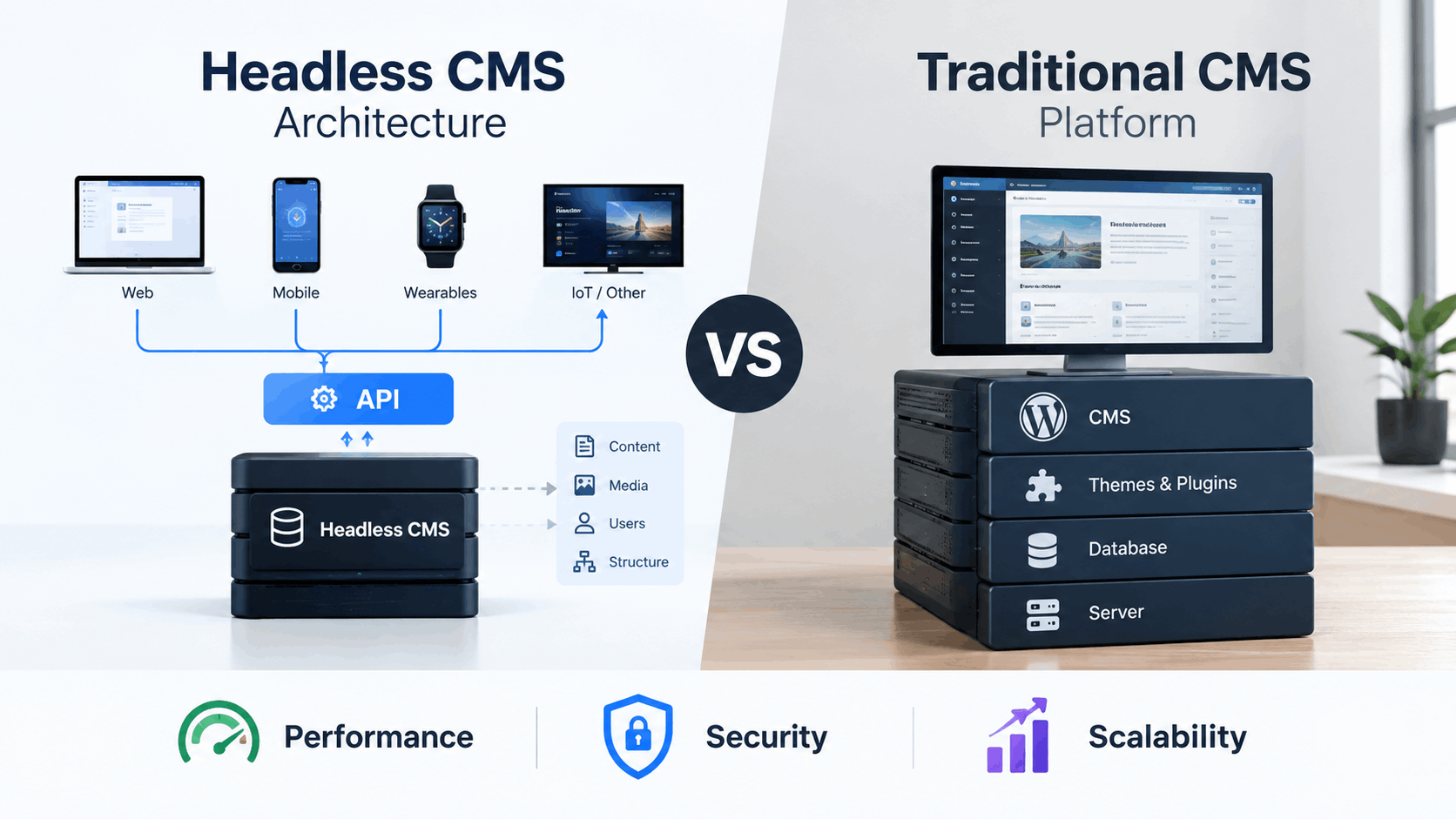
Digital experience architectures are undergoing their most significant shift in a generation. For over two decades, traditional content management systems (CMS) like WordPress, Drupal, and Joomla powered the web by tightly coupling the content database, administrative backend, and presentation frontend into a single monolith.
While monolithic systems enabled millions of organizations to establish a web presence without specialized development teams, modern performance demands, omni-channel publishing requirements, and evolving cybersecurity threat vectors have exposed the limitations of this legacy approach.
Headless CMS architecture—and its broader ecosystem counterpart, composable architecture—redefines how content is managed, structured, and delivered across modern digital ecosystems. By decoupling the content repository from the presentation layer, engineering teams gain fine-grained control over execution environments, cache behavior, network topology, and attack surface reduction.
Defining the Structural Split: Monolith vs. Decoupled Architecture
To understand why enterprise organizations migrate to headless systems, we must analyze the structural mechanics of both paradigms.
Traditional Monolithic CMS Architecture
In a traditional platform, a single application handles every stage of the content lifecycle. When a user requests a web page, the following sequence occurs:
- The web server (e.g., Apache or Nginx) routes the request to the backend execution environment (e.g., PHP engine).
- The core application queries a relational database (typically MySQL or MariaDB) to fetch raw content, metadata, theme settings, and active plugin configurations.
- The server executes business logic, renders the dynamic content into HTML templates using server-side execution, and injects inline styles and assets.
- The final HTML page is returned over HTTP to the client browser.
This model couples content management with rendering logic. While convenient for simple sites, it creates systemic inefficiencies at scale. Database read/write lock conditions, server processing overhead, and heavy plugin dependencies reduce overall execution efficiency.
Headless CMS Architecture
A headless CMS operates exclusively as a content repository accessible via APIs (Application Programming Interfaces). It abstracts away the presentation layer entirely.
- Content Administration: Authors create, edit, and store structured content (JSON/GraphQL payloads) within a database optimized for content storage.
- API Engine: The CMS exposes secure endpoints via RESTful HTTP or GraphQL APIs.
- Presentation Layer (Head): Independent frontend frameworks (such as Next.js, Nuxt.js, Remix, SvelteKit, or native iOS/Android applications) consume content from the API.
- Delivery Infrastructure: Frontend applications pre-render static HTML at build time (Static Site Generation – SSG) or fetch dynamic data at the edge via Server-Side Rendering (SSR) and Incremental Static Regeneration (ISR).
By separating content storage from user delivery, developer teams can select optimal frameworks for each specific channel, eliminating reliance on proprietary CMS template engines.
Deep-Dive Architectural Comparison
The architectural differences between monolithic and headless platforms impact software engineering workflows, deployment models, and infrastructure maintenance.
| Architectural Dimension | Traditional Monolithic CMS | Headless CMS Architecture |
| Frontend/Backend Coupling | Tightly Coupled | Strictly Decoupled |
| Data Delivery Mechanism | Dynamic Server-Side HTML Rendering | Structured Data Payloads (JSON, GraphQL via APIs) |
| Technology Stack Constraints | Locked to database/language of platform (e.g., PHP/MySQL) | Tech-Agnostic (React, Vue, Svelte, Swift, Kotlin, Rust) |
| Content Reusability | Page-centric; locked to platform web views | Channel-agnostic; consumable by Web, Mobile, IoT, Kiosks |
| Deployment Pipelines | Monolithic deployments (content + code combined) | Isolated CI/CD pipelines for frontend and backend API |
| Caching Dynamics | Complex full-page and object caching (Varnish, Redis) | Edge-native caching, Static Site Generation (SSG), CDN-first |
| Infrastructure Overhead | High (Requires database maintenance, OS patches, server tuning) | Reduced (SaaS/API managed, frontend hosted on edge CDNs) |
Performance Engineering: Execution Models and Edge Delivery
Performance directly influences search engine ranking, user retention, and conversion rates. Traditional platforms suffer from architectural drag, whereas headless systems leverage edge computing and static compilation.
The Monolithic Execution Bottleneck
Traditional CMS platforms compute pages on demand during runtime unless complex caching layers are configured. The standard dynamic request pipeline faces distinct performance bottlenecks:
- Database Connection Overhead: Every request triggers multiple database queries. Heavy database lookups increase Time to First Byte (TTFB).
- Script Parsing Execution: Executing complex application scripts (e.g., hundreds of active WordPress plugins or Drupal modules) consumes server CPU memory for every un-cached request.
- Render-Blocking Resources: Monolithic themes often inject unoptimized, redundant CSS and JavaScript libraries across all pages regardless of actual component usage.
While caching engines like Redis or Varnish help mitigate these delays, cache invalidation in large-scale monolithic environments remains notoriously volatile and prone to stale content issues.
Headless Performance Optimization Techniques
Headless architectures utilize modern frontend rendering strategies that dramatically optimize core web performance metrics.
1. Static Site Generation (SSG)
During the build step, the frontend framework fetches all content from the headless API, compiles HTML files, and deploys them to a Distributed Content Delivery Network (CDN). When a request hits the network, the CDN serves pre-compiled static assets instantly. The server processing time approaches zero, resulting in ultra-low TTFB globally.
2. Incremental Static Regeneration (ISR)
To avoid rebuild times for large sites with hundreds of thousands of pages, ISR allows developers to update static pages in the background without rebuilding the entire application. When content changes in the CMS, only affected paths are invalidated and re-generated on the edge upon the next incoming request.
3. Edge-Side Rendering (ESR) and Serverless Functions
Modern edge platforms run lightweight V8 JavaScript engine instances close to the user’s physical location. Personalization, localization, and A/B testing occur at the network edge rather than in a central backend database server, keeping execution delays under 20 milliseconds.
4. Fine-Grained Asset Optimization
Frontend frameworks automatically split JavaScript bundles, generate modern image formats (AVIF/WebP) on demand, and inline critical CSS path rendering.
Modern research from educational computing centers highlights how static resource pre-compilation directly minimizes network payload sizes and client CPU parsing times. For further reading on high-performance network strategies, refer to resources provided by the National Center for Supercomputing Applications at UIUC.
Cybersecurity Analysis: Reducing the Attack Surface
Evaluating software architecture requires assessing risk vectors, patch maintenance requirements, and vulnerability exposure profiles.
Security Vulnerabilities in Traditional CMS Environments
Monolithic platforms are among the most frequently targeted web systems globally. Their design creates several systemic security challenges:
- Exposed Administrative Surfaces: The backend database, application code, authentication portals, and user-facing frontend reside on the same server accessible via standard web ports.
- Plugin and Extension Vulnerabilities: Monolithic ecosystems rely on third-party plugins for extended functionality. Third-party extensions represent the single largest entry point for SQL Injections (SQLi), Cross-Site Scripting (XSS), and Remote Code Execution (RCE) attacks.
- Database Co-Location Risks: If a vulnerability allows an attacker to breach the presentation server, they directly gain read/write access to the database containing credentials, system logs, and private user data.
- DDoS Vulnerability: Uncached endpoints can be targeted by Denial of Service attacks that saturate database connections and exhaust application memory pools.
Security Enhancements in Headless Architecture
Decoupling content storage from public-facing applications fundamentally transforms the security topology.
1. Total Attack Surface Reduction
When using static generation (SSG) alongside a headless CMS, there is no database running on the public-facing web server. The public point of contact is a static CDN node serving pre-compiled HTML, CSS, and asset files. SQL injection techniques become ineffective because there is no SQL database engine attached to the user-facing application request path.
2. Hidden Content Repositories
The headless CMS administration interface operates on isolated domains or private networks (e.g., behind a VPN or IP-restricted gateway). Attackers cannot easily brute-force login routes or exploit application-level endpoints because the administrative API is entirely hidden from standard web traffic.
3. Read-Only Data Streams
Public frontend applications access content via read-only APIs protected by API keys, token authentication, or rate limits. Even if a public-facing website experiences an emergency service degradation, the backend content repository remains unaffected and protected from data corruption.
Detailed standards on network isolation, API endpoint security, and access control models are regularly updated by the Cybersecurity and Infrastructure Security Agency (.gov), which emphasizes isolating data repositories from public presentation tiers.
Scalability and Infrastructure Costs
Scalability measures how effectively an architecture responds to traffic growth without performance degradation or cost inflation.
Scaling Monolithic Infrastructure
Scaling a monolithic application requires scaling every component of the stack simultaneously (vertical or complex horizontal scaling):
- Vertical Scaling: Upgrading server hardware resources (RAM, CPU core count). This approach hits a physical ceiling and incurs significant hardware costs.
- Horizontal Scaling: Deploying multiple application servers behind a load balancer. This introduces substantial architectural complexity, requiring shared file systems (e.g., NFS), distributed session stores (e.g., Redis cluster), and database replication topologies (Primary/Replica setups with auto-failover).
When traffic spikes unexpectedly, monolithic platforms take minutes to spin up heavy virtual machines, often leading to server timeouts during critical load events.
Scaling Headless Infrastructure
Headless platforms split the scaling challenge into two independent vectors, allowing engineering teams to scale each tier cost-effectively.
1. Edge-Based Scale
Serving content via CDNs means global infrastructure handles scaling automatically. Edge networks handle millions of concurrent requests seamlessly without touching the origin CMS server, shielding the core system from traffic spikes.
2. Cost Infrastructure Efficiency
Because static assets consume far less memory and CPU time than dynamic application environments, hosting static or edge-computed frontends costs a fraction of running clustered monolithic server farms.
3. API Rate Buffering
During peak events, edge networks use aggressive API caching layers. The backend headless CMS processes only a minuscule fraction of real-time requests, keeping administrative performance smooth even during viral traffic moments.
The architectural principles behind serverless and distributed edge networks align with high-performance computing frameworks documented by researchers at the Lawrence Berkeley National Laboratory.
SEO and Digital Experience Optimization
Optimizing digital properties for search engines requires fast technical execution, clear structured data output, and flexible rendering strategies.
Technical SEO Mechanics
Search engines prioritize performance metrics, page load speeds, and dynamic mobile responsiveness. Headless sites excel across these Core Web Vitals targets:
- Largest Contentful Paint (LCP): Pre-compiled assets and optimized image delivery pipelines allow main page content to render almost instantly upon load.
- Interaction to Next Paint (INP): Decoupled frontends reduce background JavaScript thread processing overhead, keeping input response times low.
- Cumulative Layout Shift (CLS): Modern frontend workflows prevent sudden layout shifts by explicitly reserving space for dynamic content, fonts, and responsive media.
Multi-Channel Content Distribution
Unlike legacy platforms that lock content into specific page templates, a headless CMS uses structured, structured model entries. A single content object—such as a product description or blog post—is managed once in the repository and delivered natively across multiple end-points:
- Public Web Applications (Next.js, Vue)
- Native Mobile Apps (iOS Swift / Android Kotlin)
- Smart Displays, Voice Assistants, and IoT Interface Endpoints
- Retail Kiosks and Digital Signage Systems
- In-Product Dashboards and Documentation Portals
Developer Experience (DX) and Enterprise Integration
Building enterprise digital tools requires high developer velocity, modular software designs, and modern CI/CD integration models.
Developer Experience Comparison
Traditional CMS development relies heavily on platform-specific template languages, proprietary hooks, and framework conventions (such as PHP/Twig inside specific folder structures). Onboarding developers requires specialized knowledge of the platform’s proprietary codebase.
Headless architecture decouples content storage from technical stack implementation. Software engineers work with universal web standards—JavaScript/TypeScript, React, Vue, GraphQL, REST APIs, and CSS modules. This architectural independence accelerates onboarding and allows teams to pick tools suited to their precise requirements.
Integration Frameworks and the Composable Stack
Headless CMS platforms form the foundation of the MACH architecture (Microservices, API-first, Cloud-native SaaS, Headless). This composable framework lets enterprises construct modular technology ecosystems by integrating best-in-breed specialized services:
- Headless CMS: Content infrastructure management.
- Headless E-Commerce: Transaction and cart management engines (e.g., Commercelayer, Shopify Plus API).
- Algolia / Typesense: High-performance contextual search engines.
- Digital Asset Management (DAM): Centralized high-resolution media management.
- Customer Data Platforms (CDP): Real-time analytics and user segmentation.
Integrating these specialized systems via RESTful APIs avoids monolithic platform lock-in and lets teams upgrade individual tech stack components without rebuilding the entire system.
Strategic Decision Matrix: When to Choose Which Architecture
While headless CMS architecture delivers undeniable technical advantages, it is not universally required for every project scope. Choosing the right platform depends on team capabilities, budget models, and long-term digital strategy goals.
Choose a Traditional Monolithic CMS If:
- Budget and Resources are Constrained: Small to mid-sized teams need an out-of-the-box system requiring minimal custom development.
- Content Teams Require Built-In Themes: Non-technical users need direct visual page-building capabilities without relying on dedicated engineering teams for frontend layout changes.
- Single-Channel Focus: The content is published exclusively to a standard website without requirements for mobile app APIs or cross-platform distribution.
- Standard Site Capabilities: The project relies on standard, off-the-shelf plugins for forms, basic SEO management, and standard e-commerce setups.
Choose a Headless CMS Architecture If:
- High Performance and Global Scale are Essential: Achieving exceptional Core Web Vitals and low TTFB across international audiences is business-critical.
- Multi-Channel Delivery is Required: Content must seamlessly feed web platforms, native mobile applications, smart devices, and internal software tools simultaneously.
- Security is a Top Priority: The application processes sensitive user data or operates in heavily regulated industries (finance, healthcare, enterprise SaaS) requiring isolated attack surfaces.
- Advanced Engineering Pipelines: The organization maintains a dedicated software engineering team building modular, modern web applications.
- Future-Proofing Infrastructure: The technology roadmap requires flexibility to update or replace frontend frameworks over time without undergoing complex database migration processes.
Architectural Synthesis
The choice between a headless CMS architecture and a traditional platform represents a fundamental decision about software design philosophy. Monolithic platforms continue to serve simple web publishing needs well, but modern digital experiences demand performance, security, and scalability that coupled systems struggle to deliver cleanly.
Decoupled architectures decouple presentation logic from data management, giving organizations the tools to build fast, secure, and globally scalable software systems. By adopting API-first content models and leveraging edge delivery networks, forward-thinking enterprises establish a resilient foundation capable of supporting ongoing technological change.