
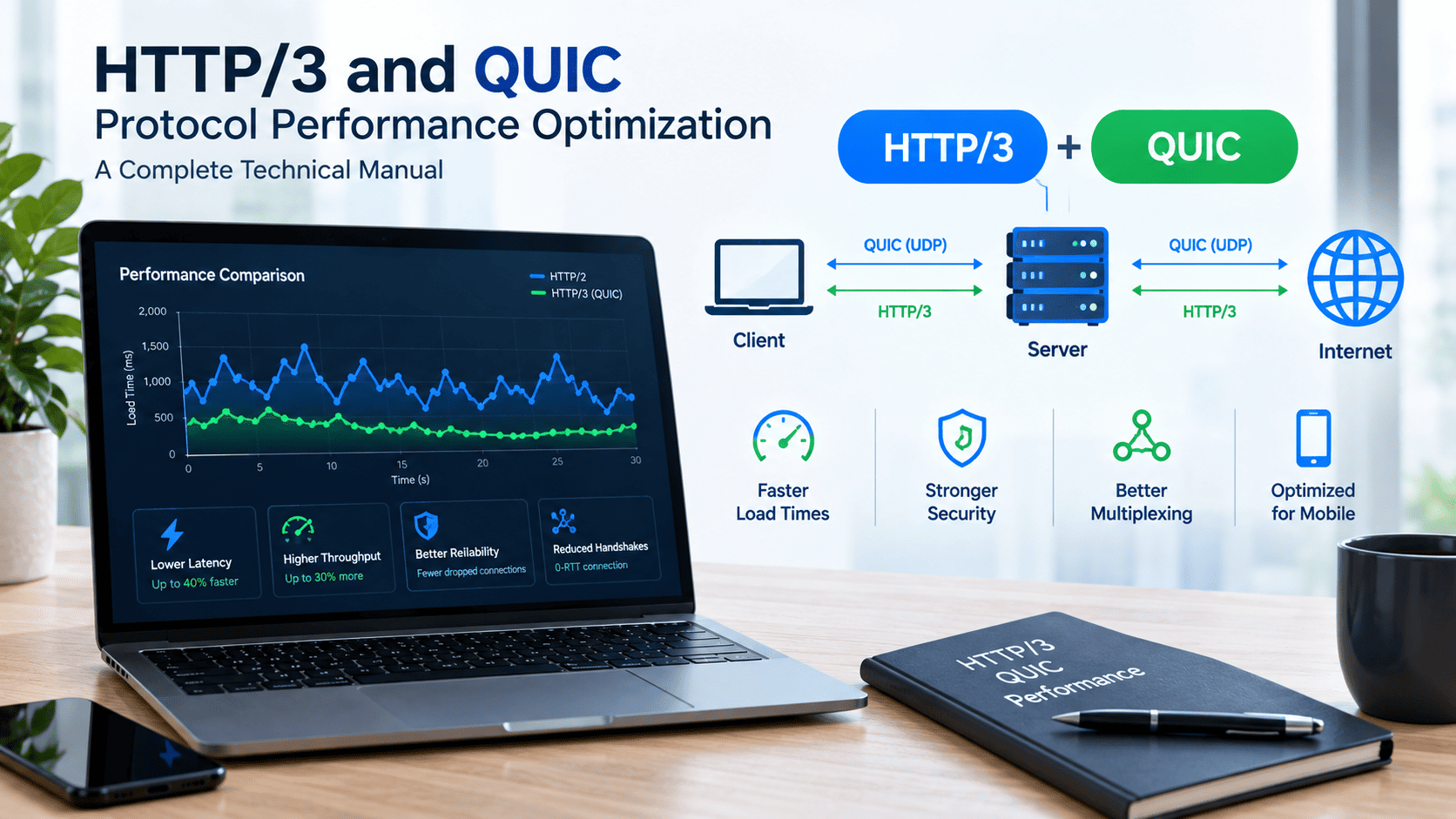
TCP has run the web since before the web existed as a public thing. Every optimization technique built on top of it — connection pooling, domain sharding, keep-alive tuning — was ultimately working around limitations baked into a transport protocol designed in the 1970s for a network with entirely different loss and latency characteristics than the one we run today. HTTP/3, built on QUIC, is the first mainstream transport-layer rebuild in the web’s history, and by 2026 it has moved well past experimental status: browser support sits above 92 percent globally, and somewhere between roughly a fifth and two-fifths of the top sites on the internet serve it today, depending on whose measurement methodology you trust.
That range in the data is itself informative. HTTP/3 adoption isn’t stalling because engineers don’t understand its benefits — it’s stalling in places because deployments are misconfigured, under-tuned, or rolled out without the operational changes QUIC actually requires to perform well. This manual is written for architects and engineers who already know HTTP/3 exists and want to understand exactly how to configure, measure, and tune it so it delivers the gains the protocol is capable of, rather than quietly underperforming the HTTP/2 stack it’s meant to replace.
Why TCP Ran Out of Road
To optimize QUIC intelligently, you need to understand precisely what problem it was built to solve, because the fix only makes sense in light of the failure mode.
HTTP/2 introduced multiplexing at the application layer — multiple logical streams sharing a single TCP connection, eliminating the need for browsers to open six parallel connections per origin. On paper, that solved head-of-line blocking. In practice, it moved the problem down a layer rather than removing it. TCP delivers bytes as a single ordered stream. If one packet is lost, every byte behind it in that stream — regardless of which HTTP/2 stream it logically belongs to — has to wait for retransmission before any of it can be delivered to the application. A lost packet carrying an unrelated image request could stall the JavaScript bundle sitting right behind it in the same TCP connection, even though the two have nothing to do with each other.
This is why, on genuinely lossy networks, naive multi-connection HTTP/1.1 sometimes outperformed HTTP/2 in practice — brute-force parallelism across independent TCP connections avoided a single shared bottleneck that HTTP/2’s efficiency gains had inadvertently created. That irony is the exact gap QUIC was designed to close.
What QUIC Actually Changes at the Transport Layer
QUIC, standardized as RFC 9000 by the IETF, is not “TCP with a new name.” It is a ground-up reimplementation of transport-layer reliability, congestion control, and flow control, running over UDP instead of directly implementing a new IP-layer protocol — a pragmatic choice that let QUIC deploy through existing network middleboxes without requiring operating system kernel changes or new routing hardware.
Independent Stream Delivery
QUIC implements multiplexing natively at the transport layer rather than layering it artificially on top of an ordered byte stream. Each QUIC stream is delivered and retransmitted independently. A lost packet carrying data for one stream stalls only that stream; every other stream on the same connection continues delivering data to the application without interruption. This is the direct structural fix for the head-of-line blocking problem that HTTP/2 could only partially address.
Connection Establishment in 0 to 1 Round Trips
Traditional HTTPS requires a TCP handshake followed by a separate TLS handshake — commonly two to three round trips before any application data moves. QUIC integrates encryption directly into the transport handshake, using TLS 1.3 as a mandatory component rather than a bolt-on layer, and can complete a full secure connection setup in a single round trip for a first-time connection. For a returning client that has previously connected to the same server, QUIC supports 0-RTT resumption: the very first packet the client sends can carry an actual HTTP request, with the server responding immediately, no handshake round trip required at all. On high-latency or mobile connections, that difference is not marginal — it routinely accounts for a meaningful share of perceived page-load improvement.
Connection Migration via Connection IDs
TCP connections are bound to a four-tuple: source IP, source port, destination IP, destination port. Change any one of those — most commonly, a mobile device switching from WiFi to cellular — and the TCP connection breaks, forcing a full re-handshake. QUIC identifies connections using a Connection ID that is independent of the underlying IP address and port. When a client’s network path changes mid-session, the QUIC connection survives the transition without dropping, because the server continues to recognize the session by its Connection ID rather than by network-layer addressing. This single feature is disproportionately responsible for QUIC’s real-world advantage on mobile networks, where path changes are routine rather than exceptional.
Built-In Loss Recovery and Congestion Control Improvements
QUIC carries richer acknowledgment information than TCP, including explicit signaling that disambiguates retransmissions from original transmissions — a distinction TCP historically struggled with, contributing to inaccurate round-trip-time estimation under loss. This lets QUIC’s congestion control algorithms react to actual network conditions more precisely, and QUIC implementations are free to iterate on congestion control logic in user-space software rather than waiting on operating system kernel updates, which historically slowed TCP congestion control innovation to a multi-year cadence.
The Honest Tradeoff: Where QUIC Costs More Than It Saves
A rigorous technical manual has to include the case against blind enthusiasm, because the data from 2026 production deployments is unambiguous on this point: QUIC’s advantages are conditional, not universal, and pretending otherwise leads to poorly targeted optimization work.
The core issue is CPU cost. TCP’s acknowledgment and retransmission logic runs largely in kernel space, optimized over decades and, on many systems, partially offloaded to network interface hardware. QUIC’s equivalent logic runs in user space by design — the same design decision that makes it possible to iterate quickly on QUIC’s congestion control also means the server’s CPU does meaningfully more work per connection generating and processing acknowledgments compared to TCP. On networks with abundant bandwidth and low loss rates, this CPU overhead can actually make QUIC measurably slower in wall-clock terms than the HTTP/2-over-TCP stack it replaces, because the protocol is paying a real computational cost to solve a head-of-line blocking problem that essentially never manifests on a clean, high-bandwidth path in the first place.
This produces a genuinely useful operational rule: QUIC’s benefit scales with a network path’s loss rate and latency, and its cost scales with connection volume and available bandwidth. The two curves cross at a specific point, and that crossing point is why adoption has plateaued unevenly across regions — markets with lower median bandwidth and higher mobile-network variability (parts of Latin America, South Asia, and Southeast Asia consistently show this in current adoption data) see HTTP/3 outperform decisively, while stable, high-bandwidth fixed-line environments see far smaller, sometimes negative, gains unless the server-side implementation has been specifically tuned to reduce per-packet CPU overhead.
Measured Performance Gains by Network Condition
The following comparison reflects the pattern consistently reported across current production benchmarking, illustrating why network conditions — not raw protocol superiority — should drive your optimization priorities.
| Network condition | HTTP/2 over TCP | HTTP/3 over QUIC | Practical implication |
|---|---|---|---|
| Stable fixed-line broadband, low packet loss | Strong baseline performance | Often comparable, sometimes marginally slower due to CPU overhead | Prioritize server CPU efficiency before enabling HTTP/3 broadly |
| Mobile network with moderate packet loss | Noticeable HOL blocking under loss | Meaningful improvement, particularly for parallel asset loading | Strong candidate for HTTP/3 as default |
| High-latency international routes | Multiple RTTs before first byte | Substantial reduction via 0-RTT and 1-RTT handshakes | High-value target for HTTP/3 prioritization |
| Network path changes (WiFi to cellular handoff) | Full connection drop and re-handshake | Session continuity via Connection ID migration | One of QUIC’s clearest, least conditional wins |
| High-volume, CPU-constrained server environment | Lower per-connection CPU cost | Higher per-connection CPU cost without GRO/GSO tuning | Requires kernel-level offload tuning before scaling HTTP/3 traffic |
Server-Side Configuration for Real Performance Gains
Enabling HTTP/3 without addressing the operational details below is the single most common reason organizations report disappointing results. The protocol’s theoretical advantages depend on infrastructure-level tuning that doesn’t happen automatically.
1. Enable UDP Generic Segmentation and Receive Offload
Because QUIC runs over UDP, the CPU savings that TCP gets from hardware-assisted segmentation and reassembly (TSO/GRO) historically weren’t available to it. Modern Linux kernels support UDP GSO (Generic Segmentation Offload) and GRO (Generic Receive Offload), allowing the network interface to batch multiple UDP datagrams into a single kernel-to-userspace transition instead of processing packets one at a time. Deploying HTTP/3 at scale without enabling these kernel features is the most common single cause of the “QUIC is slower on fast networks” result reported in current benchmarking — the fix is available, it simply isn’t universally enabled by default.
2. Advertise HTTP/3 Correctly With the Alt-Svc Header
Browsers do not attempt HTTP/3 by default against a server they haven’t previously confirmed supports it. Servers must advertise availability using the Alt-Svc response header on their existing HTTP/2 or HTTP/1.1 responses, informing the client that HTTP/3 is available on a given port for a defined duration. Skipping this header is a surprisingly common misconfiguration: the server has QUIC fully enabled and functioning, but clients simply never discover it and continue using HTTP/2 indefinitely.
3. Tune Congestion Control Algorithm Selection
Most modern QUIC implementations default to a BBR or CUBIC-derived congestion control algorithm, but the optimal choice depends on your traffic profile. BBR-family algorithms tend to perform better for latency-sensitive, bursty traffic patterns typical of interactive web applications; CUBIC-derived approaches can be more conservative and stable for sustained, high-throughput transfers. This is a tunable parameter in most production QUIC stacks (including implementations used by major CDNs and web servers such as nginx and Caddy) and is worth benchmarking against your actual traffic rather than accepting the default uncritically.
4. Configure Connection ID and Retry Handling for DDoS Resistance
QUIC includes a built-in anti-amplification protection: an unverified client cannot receive more than three times the number of bytes it has sent to the server, closing off the reflection-amplification vector that has historically plagued UDP-based protocols including DNS and NTP. Beyond this baseline protection, production deployments handling meaningful public traffic should enable QUIC’s retry mechanism, which forces a validating round trip before committing server-side connection state — a defense against connection-flooding attacks that is not always enabled by default and needs to be explicitly configured.
5. Set 0-RTT Policy Deliberately, Not by Default
0-RTT resumption is QUIC’s fastest path, but it comes with a real security tradeoff: data sent in the 0-RTT phase is replayable by an attacker who captures the initial packet, because it isn’t protected by the same forward-secrecy guarantees as data sent after the full handshake completes. For idempotent requests — most GET requests for static or cacheable content — this risk is generally acceptable. For anything state-changing (a payment submission, an account action), 0-RTT should be explicitly disabled or the request rejected server-side if it arrives during the 0-RTT window. This is a deliberate architectural decision, not a checkbox to leave on defaults.
Measuring HTTP/3 Performance Correctly
A recurring failure in HTTP/3 rollouts is measuring the wrong thing. Synthetic lab tests on stable, low-latency connections routinely understate — or in some cases invert — the real-world benefit, because they don’t reproduce the packet loss and variable-latency conditions where QUIC’s architecture actually pays off.
- Segment your Real User Monitoring (RUM) data by connection type and geography, not just by aggregate average. A global average can mask the fact that HTTP/3 is delivering a substantial win for mobile users in high-latency regions while showing negligible or negative impact for fixed-line users in low-latency markets.
- Track Core Web Vitals alongside raw transport metrics. Time to First Byte and connection setup time are the most directly QUIC-sensitive metrics; Largest Contentful Paint and Interaction to Next Paint capture whether the transport-layer gains actually translate into perceived experience improvements.
- Capture packet loss rate as a first-class dimension of your monitoring, not an afterthought. Given that QUIC’s benefit scales directly with loss rate, any performance comparison that doesn’t account for the loss conditions each measurement was taken under is comparing incompatible samples.
- Use protocol-aware packet capture tools during investigation. Wireshark’s QUIC dissector, combined with TLS key logging enabled on the client, allows genuine visibility into handshake timing, stream multiplexing behavior, and retransmission patterns that HTTP-layer monitoring alone cannot show.
- Validate Alt-Svc discovery is actually working by confirming, via browser developer tools or server access logs, what fraction of eligible clients are actually upgrading to HTTP/3 rather than assuming enablement equals adoption.
Where QUIC and HTTP/3 Are Headed Next
The protocol family continues to evolve under active IETF standardization work, and architects planning multi-year infrastructure investments should track two developments in particular.
QUIC version 2, building on the original RFC 9000 version 1, introduces improvements including per-packet connection ID rotation intended to reduce the ability of network observers to correlate a client’s traffic across path changes — a privacy-focused refinement rather than a performance one, but relevant for any organization with regulatory obligations around user tracking and network-level privacy.
Multipath QUIC extends the protocol to use multiple network paths simultaneously for a single connection, rather than migrating between paths sequentially. This has clear applications for multi-homed servers and increasingly for mobile devices capable of maintaining simultaneous WiFi and cellular radios, allowing a connection to actively load-balance across both rather than treating one as a pure fallback for the other. Standardization work in this area continues through IETF working groups, and research groups within university computer science departments studying transport-layer protocols have published extensively on multipath scheduling algorithms and their real-world throughput implications, providing a useful body of evidence for anyone evaluating early adoption (stanford.edu).
Federal guidance on secure network protocol deployment, published through the National Institute of Standards and Technology, provides a useful baseline reference for organizations formalizing internal standards around TLS 1.3 configuration requirements that QUIC deployments depend on directly, since QUIC’s mandatory use of TLS 1.3 means any organizational TLS configuration policy now directly governs QUIC security posture as well (nist.gov). Organizations operating under U.S. federal compliance frameworks should also track guidance issued by the Cybersecurity and Infrastructure Security Agency regarding UDP-based protocol deployment and DDoS mitigation practices, given QUIC’s reliance on UDP as its underlying transport (cisa.gov).
A Practical Rollout Sequence
For architects planning or revisiting an HTTP/3 deployment, the sequence below reflects the order that avoids the most common production regressions observed across current deployments.
- Confirm your TLS 1.3 configuration is already correct and enforced, since QUIC will not negotiate on anything weaker.
- Enable HTTP/3 on a subset of traffic or a non-critical subdomain first, with Alt-Svc correctly advertised, and validate that clients are actually upgrading rather than assuming success from server logs alone.
- Enable UDP GSO/GRO kernel offload before scaling to meaningful production traffic volume, and benchmark CPU utilization per connection against your existing HTTP/2 baseline.
- Set an explicit 0-RTT policy distinguishing idempotent from state-changing requests, rather than accepting a blanket default.
- Segment your monitoring by geography and connection type from day one, so that a neutral or negative aggregate result doesn’t obscure a strong result in the mobile and high-latency segments where QUIC is actually designed to win.
- Reassess congestion control algorithm selection against your specific traffic profile rather than accepting the implementation default permanently.
Closing Perspective
HTTP/3 and QUIC represent the most substantial rethinking of web transport in a generation, and the underlying engineering — independent stream delivery, integrated encryption, connection migration, and rapid handshake negotiation — solves real, well-documented problems that HTTP/2 could only partially work around. But the protocol’s benefits are conditional on network characteristics and are not free: they cost real CPU cycles, and extracting the performance HTTP/3 is capable of delivering requires the kernel-level tuning, deliberate 0-RTT policy, and workload-aware measurement described throughout this manual.
The organizations getting genuine value from HTTP/3 in 2026 are not the ones that flipped a configuration flag and assumed the protocol would optimize itself. They’re the ones treating it the way any serious infrastructure change deserves to be treated: measured against real user segments, tuned at the kernel level, and rolled out deliberately rather than by default.