
The perimeter-based security model—famously conceptualized as the “castle-and-moat”—is officially dead. For decades, enterprise IT security relied on a clean dynamic: trust everything inside the network boundary and distrust everything outside it. Once a user, service, or packet passed the perimeter VPN or firewall, it enjoyed wide lateral access across internal network segments.
In modern cloud environments, this perimeter no longer exists. Applications are assembled across dynamic Kubernetes clusters, serverless functions, multi-cloud platforms, and third-party SaaS APIs. Workloads spin up and down in seconds, IP addresses are ephemeral, and users access corporate systems from unmanaged devices across untrusted networks.
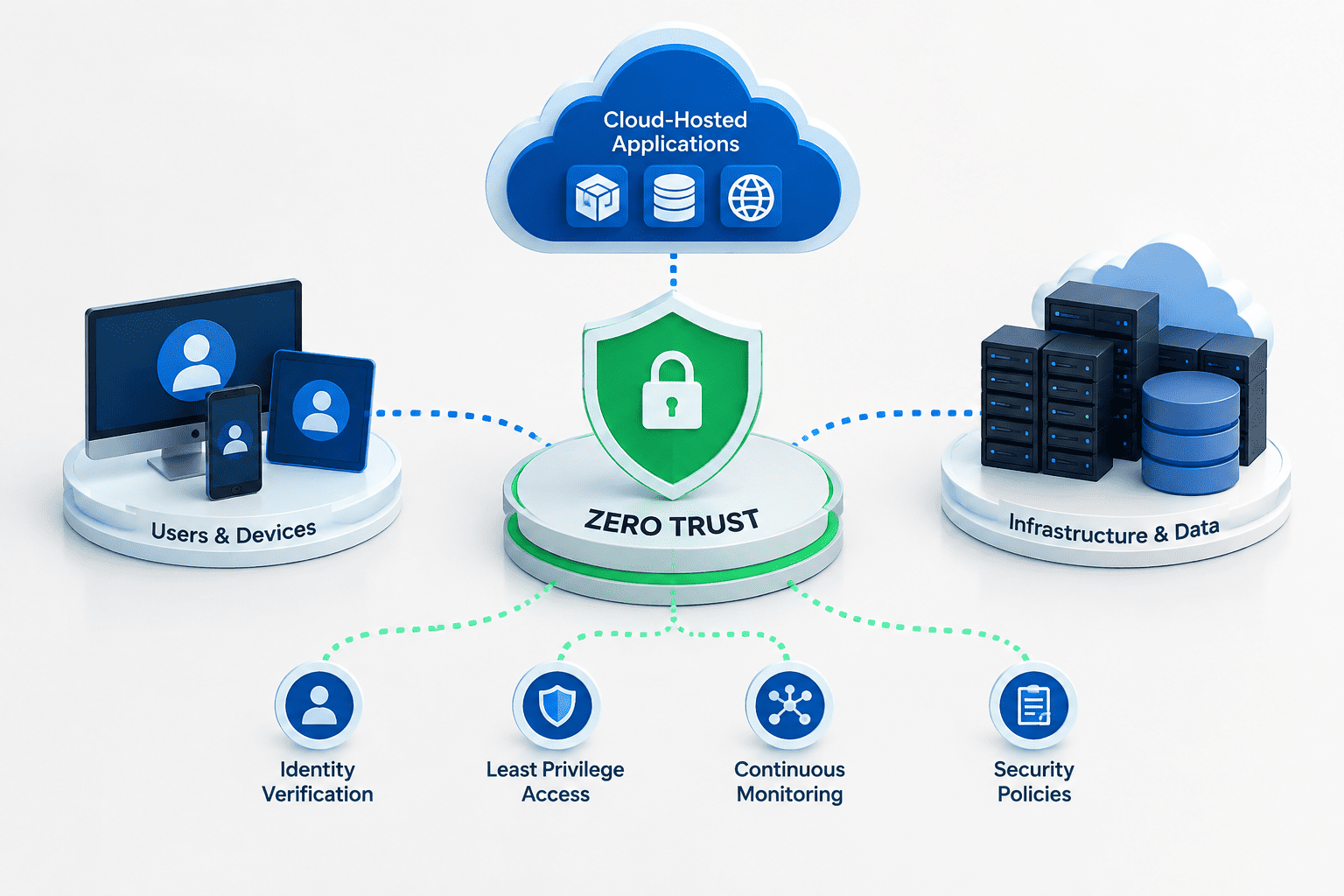
The response to this architectural shift is Zero Trust Network Architecture (ZTNA). Built on the core axiom “Never Trust, Always Verify,” Zero Trust shifts identity, authentication, and authorization from the network edge directly to every individual packet, request, and microservice transaction.
1. Core Principles of Zero Trust Architecture
Implementing Zero Trust requires moving beyond legacy network-layer controls toward continuous session evaluation. The NIST Special Publication 800-207 framework defines the blueprint for Zero Trust Architecture (ZTA), establishing three core operational pillars.
Explicit Verification
Trust is never implied by physical location, IP subnet, or network topology. Every access request must be explicitly authenticated, authorized, and encrypted before access is granted. Verification incorporates multiple signals, including user identity, device health state, workload identity, geolocation, and runtime behavior.
Least Privilege Access
Access rights are restricted using Just-In-Time (JIT) and Just-Enough-Access (JEA) models. Users and workloads receive the precise level of permissions required to complete a single task, scoped down to specific APIs, operations, and time windows.
Assume Breach
Architect systems under the assumption that attackers are already present inside the network environment. All communications are end-to-end encrypted, network traffic is continuously segmented, and full telemetry is analyzed in real time to detect anomalies and automate incident response.
2. ZTNA Architectural Components: PDP vs. PEP
A robust Zero Trust control plane separates the decision engine from the enforcement boundary. According to the framework published in the NIST SP 800-207 Zero Trust Architecture Guide, Zero Trust deployment relies on two key dynamic elements:
Policy Decision Point (PDP)
The logical entity responsible for determining whether a subject should be granted access to a resource. The PDP consists of two sub-components:
- Policy Engine (PE): Evaluates enterprise policies against incoming telemetry from identity providers (IdP), endpoint detection and response (EDR) agents, and threat intelligence feeds to make the final access decision.
- Policy Administrator (PA): Communicates with the Policy Enforcement Point to issue control commands, generating short-lived access credentials or TLS session tokens to open or close execution paths.
Policy Enforcement Point (PEP)
The inline operational entity that enables, monitors, and terminates connections between a subject and an enterprise resource. PEPs operate at various layers of the stack:
- API Gateways: Enforcing OAuth2/JWT tokens at Layer 7.
- Service Mesh Proxies (e.g., Envoy): Managing sidecar mTLS communication between cloud microservices.
- Cloud Identity-Aware Proxies (IAP): Intercepting ingress HTTP/HTTPS traffic before it reaches private application subnets.
3. Implementing Zero Trust for Cloud Workloads
Applying Zero Trust to cloud-native applications requires distinct strategies across three operational domains: user-to-application access, service-to-service communication, and secure data storage.
Domain A: User-to-Application (Ingress Security)
Traditional client-to-site VPNs grant network-level access (Layer 3/4), exposing the entire subnet if a single set of credentials is compromised. In contrast, Zero Trust Identity-Aware Proxies expose specific applications at Layer 7 without ever assigning the user an internal IP address.
Access Flow Sequence
| Sequence | Origin | Destination | Action / Mechanism |
| Step 1 | Endpoint User | Identity Provider (IdP) | User requests application access; triggers Multi-Factor Authentication (MFA) and device compliance evaluation. |
| Step 2 | IdP | Endpoint User | Upon success, IdP issues a cryptographically signed identity token (OIDC / JWT) containing identity claims and device context. |
| Step 3 | Endpoint User | Identity-Aware Proxy (PEP) | User presents request along with the identity token to the application ingress gateway. |
| Step 4 | Identity-Aware Proxy | Policy Engine (PDP) | PEP queries Policy Engine to validate authorization rules, contextual signals, and authorization scope. |
| Step 5 | Policy Administrator | Identity-Aware Proxy | PDP authorizes access; PA sends short-lived session confirmation to the PEP. |
| Step 6 | Identity-Aware Proxy | Internal Cloud Workload | PEP forwards request over an encrypted connection; resource processes request without exposing internal network ports to the internet. |
Domain B: Service-to-Service (East-West Traffic)
Within a cloud account or Kubernetes cluster, microservices continuously exchange data. Relying on simple security group firewall rules based on static IP addresses creates operational fragility and poor security posture. Zero Trust uses mutual TLS (mTLS) combined with cryptographic identities to secure East-West application paths.
Cryptographic Workload Identification with SPIFFE/SPIRE
To achieve workload identity, cloud applications utilize standards like SPIFFE (Secure Production Identity Framework for Everyone). SPIRE issues short-lived X.509 certificates directly to running containers based on runtime attestations (e.g., Kubernetes namespace, service account, container image digest).
Microservice Communication Execution
| Step | Component | Action Description |
| 1. Attestation | SPIRE Agent | Scans running container runtime metadata (Kubernetes Pod UID, namespace, node identity) to verify workload integrity. |
| 2. Certificate Issuance | SPIRE Server | Issues an ephemeral X.509 SVID certificate containing a SPIFFE ID (spiffe://cluster.local/ns/default/sa/payments-service) to the application container or sidecar proxy. |
| 3. Session Initiation | Service A Sidecar | Initiates mTLS connection to Service B, presenting its X.509 certificate during TLS handshake. |
| 4. Identity Verification | Service B Sidecar | Validates Service A’s certificate against the shared SPIFFE trust bundle and evaluates explicit Layer 7 RBAC policies (e.g., allow POST /v1/charge from payments-service). |
| 5. Data Transfer | Service A & B | Payload is transferred across an encrypted, authenticated pipeline. Session keys expire automatically within minutes to limit compromise windows. |
Domain C: Data Protection and Cloud KMS Integration
Zero Trust dictates that data must be protected both at rest and in transit. Encrypting data at rest requires strict isolation between storage engines and customer-managed encryption keys (CMEK).
Key Management Integration Matrix
| Storage Layer | Security Strategy | Key Engine | Policy Controls |
| Object Storage (S3 / GCS) | Server-Side Encryption with KMS | Cloud KMS / Vault HSM | Identity-based key access policies tied to workload service accounts; automatic 90-day key rotation. |
| Relational Databases (RDS / Cloud SQL) | Transparent Data Encryption (TDE) | Cloud KMS / HSM | Volume-level encryption using unique data keys; database connections require enforced mTLS. |
| Block Storage (EBS / Persistent Disks) | Storage Controller Encryption | Cloud KMS Default / CMEK | Encryption at the hypervisor layer; snapshot authorization restricted via JIT access requests. |
| Secrets Management | In-Memory Secret Injection | HashiCorp Vault | Dynamic secrets generation (e.g., temporary database credentials expiring in 15 minutes). |
4. Architectural Deep Dive: Microsegmentation vs. Perimeter Defense
Traditional networks rely on VLANs and subnets for segmentation. However, when an attacker breaches a flat network segment, lateral movement across adjacent workloads is straightforward. Zero Trust replaces broad network-level subnets with identity-based microsegmentation.
Architectural Comparison
| Attribute | Legacy Perimeter Architecture | Cloud Zero Trust Architecture |
| Primary Boundary | Network Perimeter (IP / Subnet / VLAN) | Cryptographic Identity & Context Boundary |
| Access Control | Static IP addresses, MAC filters, Port rules | Identity assertions (JWT, SAML), SPIFFE IDs, Contextual Risk |
| Internal Trust Level | High (Implicit trust within internal subnets) | Zero (Explicit verification required for every request) |
| Lateral Movement | Simple once edge security is bypassed | Blocked by continuous sidecar proxies and microsegmentation |
| Data Encryption | Perimeter-only (TLS offloading at ingress) | End-to-end encryption (TLS in transit, envelope encryption at rest) |
| Telemetry & Auditing | Perimeter firewall logs, connection counters | Detailed Layer 7 request logs, cryptographic provenance audit trails |
5. Designing a Cloud Zero Trust Pipeline
Deploying Zero Trust requires a structured operational pipeline. Attempting to enforce strict microsegmentation without first establishing identity and observability often leads to operational disruption.
Phase Execution Roadmap
Phase 1: Identity and Asset Discovery
- Catalog all cloud services, endpoints, serverless tasks, and data assets.
- Unify enterprise directory services into a primary cloud Identity Provider (IdP) supporting modern protocols (OIDC, SAML 2.0).
- Enforce phishing-resistant Multi-Factor Authentication (FIDO2 / WebAuthn) for all users.
Phase 2: Telemetry and Dependency Mapping
- Deploy observability sidecars or cloud trace agents across workloads.
- Map explicit application dependency graphs, noting every cross-service API call, port dependency, and database query path.
- Establish baseline behavior metrics for both user access patterns and service-to-service communication.
Phase 3: Identity-Aware Proxy & SPIFFE Implementation
- Replace legacy VPN endpoints with Identity-Aware Proxies to gate access to internal administrative consoles and private web services.
- Deploy SPIFFE/SPIRE server instances within Kubernetes clusters to automate workload identity verification.
Phase 4: Enforcing Strict Policies and Microsegmentation
- Transition service mesh configurations from “Permissive” to “Strict” mTLS mode, rejecting unencrypted and unauthenticated East-West connections.
- Apply fine-grained Layer 7 authorization policies (e.g., blocking HTTP
DELETEcalls from non-admin workloads). - Implement automated JIT privilege workflows to grant elevated database access only during active incident response tickets.
Phase 5: Continuous Risk Assessment and Automation
- Integrate Policy Engines with real-time Endpoint Detection and Response (EDR) platforms.
- Configure automated Security Orchestration, Automation, and Response (SOAR) playbooks to terminate user sessions or revoke X.509 SVID certificates instantly upon detecting compromised device posture or anomalous API traffic.
6. Challenges, Trade-offs, and Anti-Patterns
While Zero Trust significantly improves security posture, enterprise architects must navigate complex operational trade-offs during implementation.
Network Latency and Overhead
Terminating TLS connections at every service boundary adds CPU overhead and network latency. To mitigate performance bottlenecks:
- Use hardware acceleration (e.g., AES-NI extensions) on cloud compute nodes.
- Optimize TLS session resumption and keep-alive parameters across internal proxy networks.
- Leverage modern sidecar-less service mesh options (such as eBPF-based networking via Cilium) to process network security checks directly within the Linux kernel, bypassing sidecar proxy overhead.
Policy Creep and Management Complexity
As microservice counts grow into the hundreds or thousands, managing static RBAC policies becomes challenging. Without central policy orchestration, security rules become unmanageable.
- Solution: Express authorization policies as declarative code using engines like Open Policy Agent (OPA). Store policies in version control repositories (GitOps) and run static verification tests within continuous integration pipelines before deployment.
Anti-Pattern: “Zero Trust in Name Only” (ZTINO)
A common anti-pattern involves deploying an Identity-Aware Proxy at the cloud ingress point while leaving internal microservice subnets unencrypted and flat. If an attacker bypasses the ingress proxy—via compromised cloud credentials or an unpatched vulnerability in an edge-facing container—they can compromise the rest of the internal ecosystem. Zero Trust requires explicit verification at every layer of the execution stack, not just at the front door.
7. Zero Trust Governance and Compliance
Modern cybersecurity regulatory frameworks explicitly require Zero Trust implementation patterns. The Cybersecurity and Infrastructure Security Agency (CISA) Zero Trust Maturity Model outlines five distinct pillars across which organizations must evolve from initial to optimal implementations: Identity, Devices, Networks, Workloads, and Data.
Adopting these maturity capabilities directly satisfies compliance criteria across multiple major enterprise standards:
- FedRAMP High / NIST SP 800-53: Satisfies rigorous access control (AC), identification and authentication (IA), and system/communications protection (SC) controls.
- SOC 2 Type II: Provides verifiable audit trails showing that logical access to customer data is contextually authorized and continuously monitored.
- PCI-DSS 4.0: Fulfills requirements for strict network segmentation, continuous authentication, and encryption of cardholder data environments across dynamic cloud infrastructure.
By moving from static perimeter defenses to identity-centric execution controls, cloud architects can build platforms that remain resilient, verifiable, and secure—even within inherently untrusted network environments.